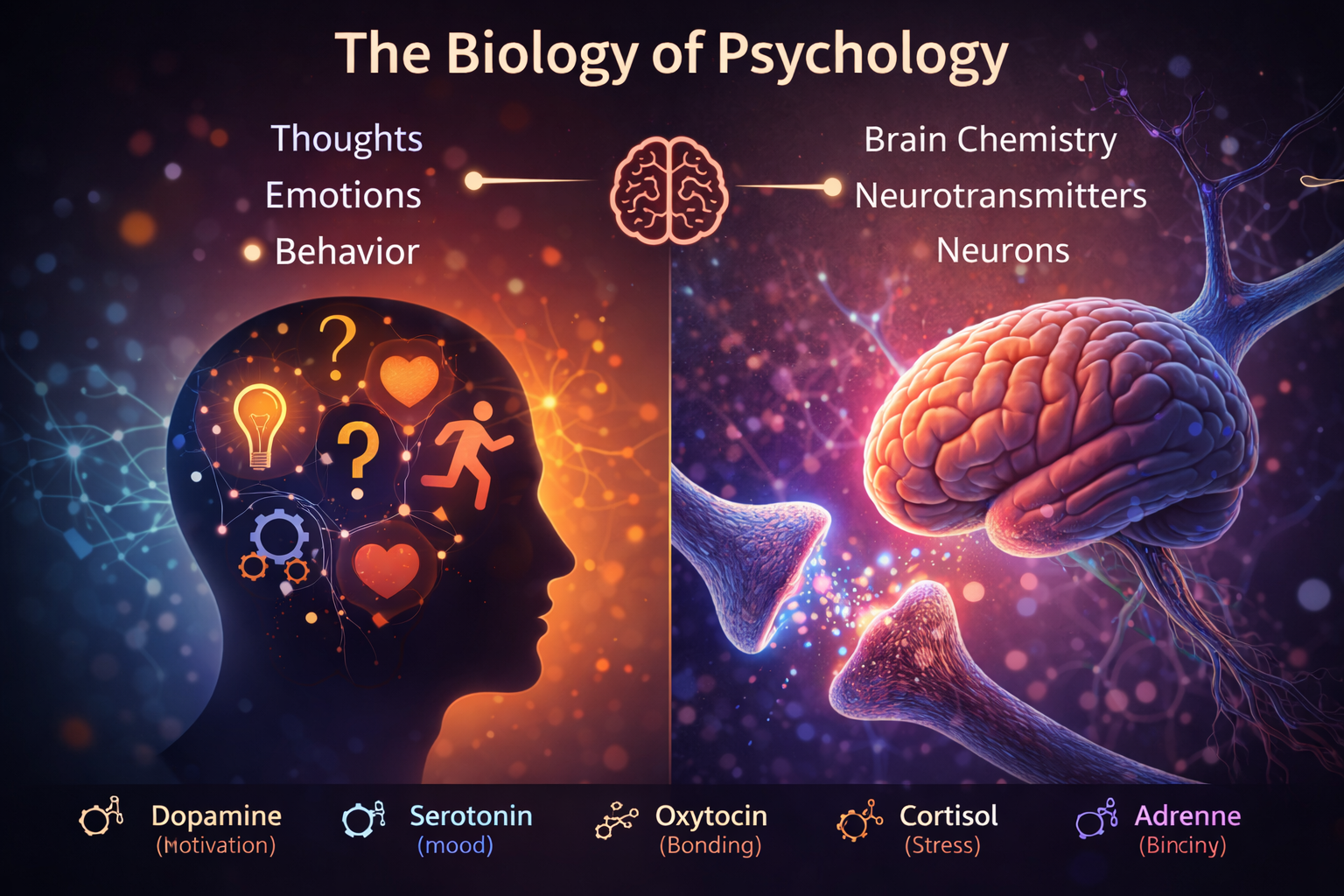
Most people think psychology is about thoughts, emotions, and behavior.
But modern science tells us something deeper:
Every psychological experience has a biological foundation.
The mind is not separate from the brain.
The mind is what the brain does.
Just like chess has simple rules yet creates millions of complex positions, the brain follows biological rules — neurotransmitter release, neural firing, hormone regulation — yet produces complex experiences like love, anxiety, ambition, jealousy, confidence, and fear.
Understanding psychology means understanding biology.
The Mind = Brain in Action
For centuries, people believed the “mind” was something abstract or spiritual. But neuroscience has shown:
- Brain damage can change personality.
- Hormonal imbalance can change mood.
- Sleep deprivation can impair decision-making.
This means:
Mind ≠ separate entity
Mind = brain function
When you feel anxious before an interview, that’s not just “emotion.”
Psychology side:
- Nervousness
- Overthinking
- Self-doubt
Biology side:
- Amygdala activation
- Cortisol release
- Increased heart rate
- Reduced prefrontal cortex control
What feels emotional is biological.
Neurons & Neurotransmitters: The Communication System
The brain is made of billions of neurons.
Neurons communicate using:
- Electrical signals (inside the neuron)
- Chemical signals (between neurons)
Those chemical messengers are called neurotransmitters.
Important distinction:
- Neurotransmitters → Fast, brain communication
- Hormones → Slower, travel through bloodstream
Now let’s explore the key neurotransmitters shaping human behavior.
Dopamine: The Motivation & Anticipation Chemical
Dopamine is often misunderstood as the “pleasure chemical.”
It is not.
Dopamine is about:
- Reward prediction
- Anticipation
- Motivation
- Learning
- Effort
The Monkey Experiment
In experiments with rhesus monkeys, researchers observed something fascinating:
Dopamine spikes did NOT occur when the reward was received.
They occurred when the signal predicting the reward appeared.
Signal → Dopamine spike → Motivation → Work → Reward
This shows dopamine drives action before pleasure.
Anticipation vs Reward
Anticipation = expecting a reward in the future.
Uncertainty = not knowing whether the reward will come.
Dopamine increases most when:
- Reward is possible
- Outcome is uncertain
This is called a variable reward schedule.
Why are social media, gambling, and video games addictive?
Because rewards are unpredictable.
The brain says:
“Maybe this time something exciting will happen.”
That uncertainty drives dopamine.
Reward Prediction Error
Dopamine does not respond to reward size alone.
It responds to the difference between:
Expected reward vs Actual reward.
If reward is better than expected → dopamine spike
If reward is worse than expected → dopamine drop
Dopamine is a learning signal.
Serotonin: Stability & Confidence
If dopamine is about chasing, serotonin is about feeling secure.
Serotonin regulates:
- Mood
- Emotional stability
- Confidence
- Sleep
- Social dominance perception
Dopamine says: “Go achieve.”
Serotonin says: “You’re safe and stable.”
Low serotonin → anxiety, irritability
Balanced serotonin → calm confidence
Oxytocin: Bonding & Trust
Often called the “love hormone,” oxytocin plays a role in:
- Romantic attachment
- Trust
- Mother-infant bonding
- Social recognition
Studies show even dogs and humans release oxytocin when they gaze at each other.
But oxytocin has a dual nature.
It strengthens bonding within a group — but can increase aggression toward outsiders.
This highlights a powerful idea:
Neurochemistry is not good or bad.
It is adaptive.
Endorphins: Natural Painkillers
Endorphins are the body’s natural opioids.
They:
- Reduce pain
- Create feelings of pleasure
- Cause runner’s high
From an evolutionary perspective, endorphins allowed humans to:
Keep running
Keep fighting
Keep surviving
Even when injured.
Pleasure here is not luxury.
It is survival reinforcement.
Adrenaline: The Survival Switch
Adrenaline activates the fight-flight-freeze response.
When danger appears:
- Blood flows to muscles
- Pain perception decreases
- Strength temporarily increases
- Focus sharpens
Adrenaline prepares you to survive immediate threats.
But in modern life, that same system activates during:
- Public speaking
- Interviews
- Social anxiety
The system built for predators now activates for presentations.
Cortisol: The Stress Regulator
Cortisol is often misunderstood as purely negative.
It is essential.
Functions:
- Regulates blood sugar
- Controls sleep-wake cycle
- Provides energy
- Helps manage stress
Morning cortisol spike helps you wake up.
The problem is not cortisol itself.
The problem is chronic elevation.
Short-term stress = adaptive
Long-term stress = harmful
The Dual Nature of Neurotransmitters
Every chemical has positive and negative effects:
Dopamine:
- Motivation
− Addiction
Serotonin:
- Confidence
− Social comparison pressure
Oxytocin:
- Love
− Aggression toward outsiders
Adrenaline:
- Survival
− Anxiety
Cortisol:
- Wakefulness
− Chronic stress
Balance determines outcome.
Complex Behavior: Not One Chemical, But Interaction
No behavior is caused by one hormone alone.
Human behavior emerges from:
- Dopamine (motivation)
- Serotonin (stability)
- Cortisol (stress)
- Adrenaline (alertness)
- Oxytocin (bonding)
- Endorphins (pain tolerance)
These systems interact constantly.
The brain is not a single switch.
It is a dynamic chemical orchestra.
The Chess Analogy
Chess has simple rules.
Yet after just eight moves, there are millions of possible positions.
Similarly:
The brain follows simple biological rules:
- Neurons fire
- Chemicals release
- Hormones circulate
But from these simple rules emerges:
- Creativity
- Love
- Jealousy
- Anxiety
- Ambition
- Civilization
Simple biological processes → complex human experience.
Final Conclusion
Psychology cannot exist without biology.
What you think.
What you feel.
What you desire.
What you fear.
All of it is grounded in neural activity and chemical signaling.
Understanding neurotransmitters is not just academic.
It explains:
- Why we procrastinate
- Why we get addicted
- Why we fall in love
- Why we feel stressed
- Why uncertainty excites us
The mind is not mysterious magic.
It is biology expressing itself as experience.
And once we understand the biology, we understand ourselves better.